The Clinical Pharmacist in Your Corner: A Healthcare Resource Most Americans Have Never Fully Used
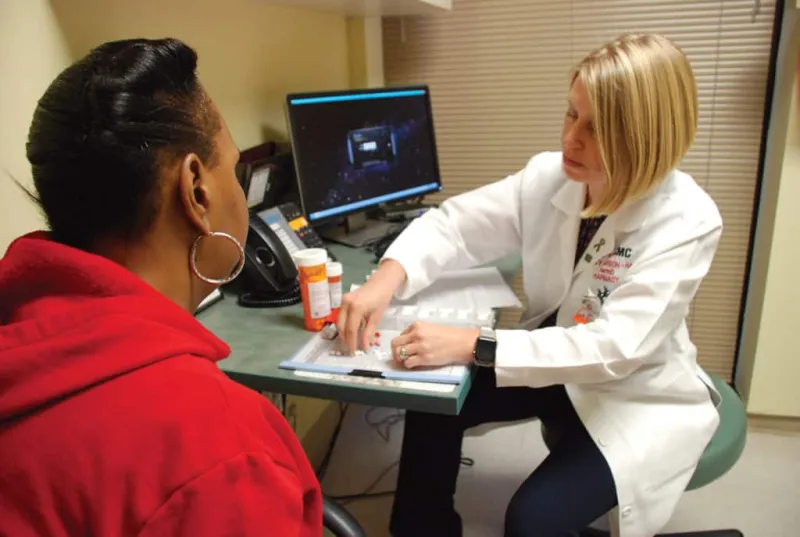
Photo: clinical pharmacist consulting patient medication review pharmacy, via www.hennepinhealthcare.org
Consider a scenario familiar to millions of Americans: a patient leaves a physician's office with a new prescription, adds it to the three or four medications already on their list, and picks it up at the pharmacy counter with minimal discussion. The pharmacist, visible behind the counter, asks whether there are any questions. The patient says no. The transaction is complete.
What was missed in that exchange may be more consequential than most patients realize.
Clinical pharmacists — professionals who hold doctoral-level training in pharmacology, therapeutics, and patient care — are among the most underutilized resources in the United States healthcare system. Their expertise extends well beyond dispensing medications. They are trained to identify drug interactions, evaluate whether a prescribed dose is appropriate for a specific patient's physiology, flag contraindications that a busy prescribing physician may not have had time to review, and counsel patients on the behavioral and lifestyle factors that influence how medications perform. And in an increasing number of clinical settings, they are doing exactly that — with measurable results.
A Credential That Commands Respect, A Role That Remains Invisible
The Doctor of Pharmacy degree, or Pharm.D., is a four-year postgraduate professional program that requires extensive clinical training in addition to rigorous coursework in chemistry, physiology, and pharmacodynamics. Many clinical pharmacists pursue additional residency training in specialized areas such as oncology, cardiology, infectious disease, or ambulatory care.
Despite this preparation, the public perception of pharmacists in the United States has historically been shaped by the retail environment — the counter, the white coat, the pill bottle. That image, while not inaccurate, is radically incomplete. Hospital systems, integrated health networks, and federally qualified health centers have long deployed clinical pharmacists as embedded members of care teams, where they conduct medication reconciliation, manage anticoagulation therapy, optimize dosing in patients with renal impairment, and lead chronic disease management programs.
What is less well known is that these same services are increasingly available to outpatient consumers — and that seeking them out may be one of the most effective, low-barrier steps a health-conscious patient can take.
The Problem Pharmacists Are Uniquely Positioned to Solve
Adverse drug events — harms caused by medications — represent one of the most significant and preventable sources of patient injury in the United States. The Centers for Medicare and Medicaid Services and the Agency for Healthcare Research and Quality have both identified medication errors as a leading contributor to preventable hospitalizations, particularly among older adults and individuals managing multiple chronic conditions.
Polypharmacy — the concurrent use of five or more medications — affects an estimated 40 percent of adults over the age of 65 in the US. As the number of medications increases, so does the complexity of potential interactions, the risk of inappropriate dosing, and the likelihood that a patient will experience side effects that go unrecognized as medication-related. In many of these cases, no single prescriber has a comprehensive view of the patient's full medication regimen, particularly when care is fragmented across multiple specialists.
This is precisely the gap that clinical pharmacists are trained to close. A comprehensive medication review conducted by a pharmacist examines not only the drugs a patient has been prescribed, but also over-the-counter medications, dietary supplements, herbal products, and the timing and method of administration — all of which can meaningfully affect therapeutic outcomes.
What a Pharmacist Consultation Actually Looks Like
For patients accustomed to brief interactions at the pharmacy counter, the concept of a structured pharmacist consultation may feel unfamiliar. In practice, it is a substantive clinical encounter.
In an ambulatory care or community pharmacy setting, a medication therapy management session — a service covered by Medicare Part D for eligible beneficiaries, and increasingly reimbursed by commercial insurers — typically involves a comprehensive medication review, identification of drug therapy problems, and the development of a personalized medication action plan. The pharmacist may communicate findings and recommendations directly to the patient's prescribing physician, creating a collaborative loop that benefits the entire care team.
For patients who are not yet eligible for Medicare, many community pharmacies and health system outpatient clinics offer direct pharmacist consultations on a scheduled basis. Patients managing conditions such as hypertension, type 2 diabetes, hyperlipidemia, asthma, or anticoagulation therapy are particularly well-served by these encounters, as these conditions involve medications with narrow therapeutic windows or significant interaction potential.
Some integrated health systems, including those affiliated with major academic medical centers, embed clinical pharmacists directly into primary care offices, where they manage chronic disease populations under collaborative practice agreements — a legal framework that allows pharmacists to initiate, modify, or discontinue drug therapy within defined parameters, without requiring a physician order for each individual decision.
When to Seek Pharmacist Expertise: A Practical Framework
For patients navigating an increasingly complex healthcare landscape, understanding when to proactively engage a pharmacist is a meaningful form of health literacy. Several situations merit particular attention.
Following a new diagnosis or the addition of a new medication, a pharmacist consultation can help contextualize the treatment decision, clarify expectations around side effects and timelines, and ensure that the new agent does not interact adversely with existing therapies.
After a hospitalization, medication reconciliation is a critical and frequently neglected step. Patients are often discharged with altered medication regimens — new drugs added, previous ones modified or discontinued — and the transition back to outpatient care is a period of elevated risk for medication error. A pharmacist review during this window can prevent readmission.
When managing multiple prescribers, patients who see a primary care physician alongside two or more specialists are at heightened risk for therapeutic duplication or conflicting treatment strategies. A pharmacist who reviews the complete medication list can identify redundancies and flag discrepancies for resolution.
When cost is a barrier to adherence, pharmacists are also well positioned to identify therapeutic alternatives, assist with prior authorization processes, and connect patients with manufacturer assistance programs — practical support that directly affects whether a patient actually takes the medication they have been prescribed.
Reframing the Pharmacist as a Clinical Partner
The healthcare system in the United States is evolving toward models that distribute clinical responsibility more broadly across care teams — and for good reason. Physician time is finite, patient complexity is increasing, and the consequences of medication mismanagement are well documented. In this context, the clinical pharmacist is not a supplement to care; in many instances, they are the most qualified professional in the room to answer the specific question being asked.
Patients who approach their pharmacist as a clinical partner — not merely a dispenser — gain access to a layer of medication expertise that most Americans have never fully utilized. Asking for a scheduled consultation, requesting a medication review, or simply engaging in a more detailed conversation at the point of dispensing are low-cost, high-value actions that align directly with the goals of informed, proactive healthcare.
At Power3 Medical, we believe that empowered patients are better patients. Knowing who is on your care team — and how to use their expertise — is a form of clinical intelligence that belongs in every patient's toolkit.